
Class/Student Books
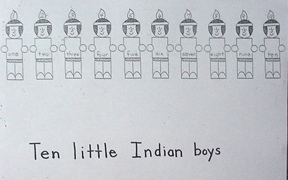
Ten Little Indians: Make a book by cutting and gluing Indian figures to numbered pages.
Animal Tracks Book: Use animal track symbols (or have students draw an animal track) and a picture of the animal to make a class book. Each illustrated page should read, “I see the _____ tracks.”
Indian Symbol Book
After reading Indian Paintbrush, make a predictable chart about Indian symbols. Display a chart of common Indian symbols. Then allow each student to choose a favorite. Record the choice on a predictable chart:
This is a teepee. (Ann)
This is a buffalo. (Blake)
Take a picture of each child holding the Indian symbol he painted onto a crumpled brown grocery bag that has been dipped in water and allowed to dry. Make this into a class book with predictable text, such as “This is a teepee,” said Ann.
Indian Symbol Circle Story
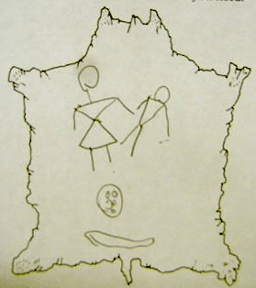
Print out a page of Native American symbols and “buffalo skin” on which to write a story using the symbols. Compile these into a class book.
Math
Feather Sort: Ask each child to bring a feather to school (or provide feathers for them.) Discuss attributes by which the feathers could be sorted (size, color, texture). After sorting the feathers according to one of the attributes, make a graph .
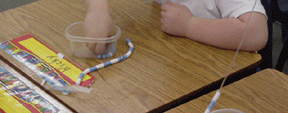
Indian Beads: String 2 or 3 colors of beads on yarn in an AABB or AABBCC pattern. Dyed macaroni and/or cereal could be used in place of real beads.
Addition/Subtraction Readiness: After reciting the poem, Ten Little Indians, talk about what occurs when you add “one more”. Use flannel board pieces or unifix cubes to act out the poem. Then do the poem in reverse and discuss “one less”.
Indian Drums: Cover a coffee can with decorated construction paper. Use the drum to create musical “patterns” or count drum beats.
Indian Counting Game
Find five small, flat stones. Paint a moon on one side of four of the stones and a star on one side of the remaining stone. Children take turns shaking the stones from a wooden bowl or basket. Children get one point for each moon and two points for a star. Each child counts his points and the one with the highest count wins. For younger children, they could count out unifix cubes as a visual connection to the number of points awarded for the moon and star symbols.
Social Studies
KWL Chart: Begin a unit by making a KWL chart about Indians (What We Know, What We want to Know, and What we Learned).
Native American Visitor: After looking at many pictures of different tribes, try to have someone of Native American descent, possibly even a parent, visit and answer questions.
Mapping Native American Tribe Locations
Find or make a flat map of the US and tiny replicas of several types of homes. Place the homes on the places around the country according to where they belonged. Put the leaf covered wigwams and long houses on the east coast and in Michigan, the teepees on the plains, a bark
covered long house on the Pacific north west, a sand covered pueblo in the southwest, a hogan in the mid-southwest and the thatched roof on poles in the Everglades.
Resource: Native American Rhymes- Native American Homes – 16 pages. Homes include Teepe, Plank house, Longhouse, Pueblo, Grass house, Pit house, Chickee, Wattle and daub, Wigwam, Igloo, Hogan
Native American Names
Discuss how many Native American names are taken from nature because nature is so important. Talk about what a tribe is and how your class can be like a tribe. Have each student give themselves Native American names by combining a describing word with a word from nature (animal, plant, weather, landform…) Or send home a note asking parents to help their child think of an appropriate name to fit their personality. Try to stick to animals that are native to your area so Flying Elephant is not a choice. Some examples of names are Silver Hawk, Mountain Flower, Chattering Chipmunk, Running Deer. Allow the students to use these names during various activities. For kindergarten, it’s another opportunity to create a new name chart for alphabet letter practice and new nametag.
This idea came from a teacher on the Kinderkorner web ring:
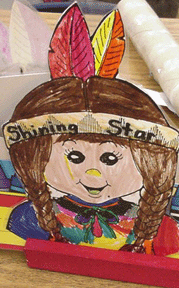
To turn a playroom into a Native American village, I covered our play loft with paper to make a pueblo, a round table with paper to make a Navaho hogan and constructed a teepee in another corner. I used real rocks and construction paper to make a council fire in the center of the room. I had a large loom near the hogan for a community weaving projects, a cardboard box canoe and ‘bear skin’ rugs near the teepee as well. We had a cabbage patch baby named ‘Little Rain Drop’ that could be wrapped in a real rabbit skin and tied onto a papoose board. They could go hunting by tossing bean bags at pop cans covered with pictures of real deer, rabbits, turkey and buffalo (Thank you, National Geographic!). They could fish from the canoe with a magnet pole. (I made felt fish with magnets sewn inside. These could be ‘cooked’ over the fire better than paper ones.) My students learned about picture writing and naming ceremonies. I had them go home and come back with a name that their family decided best described them. (I will never forget the little girl who proudly proclaimed herself ‘Chattering Chipmunk’!) Their names were added to a tagboard headband that had been painted with a pattern. We made drums from oatmeal and coffee cans and dancing bells by stringing jingle bells onto ribbons or gluing them onto a popsicle stick with hot glue and feathers. Every day at the end of the day we would have a ‘council fire’ to talk about our day and I would award feathers for good workers, good helpers, kind friends and one -only one – ‘eagle feather’ a day. Our ‘Harvest Feast’ taste fest always included venison strips, cornbread and fruit slices.
Art
Wigwam: Cut a 9″ x 11″ sheet of tagboard into 1″ x 9″ strips. Staple two strips together to make a circle for the base. Curve three strips over the base and staple in place to form the frame. Glue a coffee filter to the frame. Cut a door and fold it back. Glue leaves, straw, bits of grass, or torn brown paper bags to cover the filter and finish the wigwam. (Copycat, Nov/Dec 95)
Indian Symbols: Paint a symbol on a crumpled grocery bag that has been dipped in water and allowed to dry to make it more realistic looking. Use these symbols for a class book or to make a predictable chart.
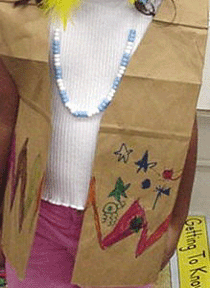
Grocery Bag Vests
Turn bag upside down and cut up the middle and around the bottom of the bag to make a hole for the neck. Cut out the sides to make armholes. Turn inside out and decorate with Indian symbols. Fringe the bottom by cutting approximately 4 inch slits about one inch apart.
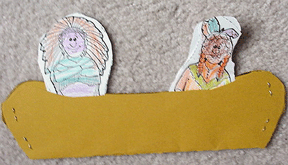
Canoes
Cut two canoe shapes from a grocery bag or index paper. Punch holes along the side and bottom edges. Sew with yarn. Glue Indian figure cut-outs inside the canoe.
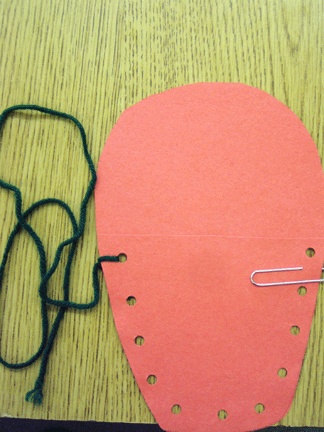
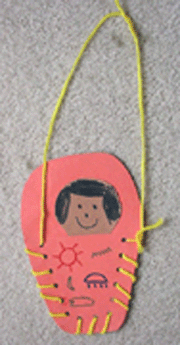
Papoose
Stack two pieces of construction paper and cut two rectangles (approximately 8 inches x 6 inches). Keeping the two pieces stacked, round the corners of the rectangles. Make a horizontal cut across one of the rectangles approximately one-third of the way down. Punch holes through both of the stacked pieces around the edges. Use yarn to sew through the holes and create a pocket. Decorate an Indian baby figure and place in the papoose. Tie a length of yarn to the top edges of the pocket so the papoose can be worn on the child’s back.
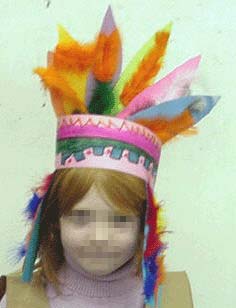
Indian Headbands
Decorate a sentence strip with geometric shapes. Fit to child’s head and staple. Glue craft feathers to paper feather cutouts and then staple these feathers to the band. For a more realistic look, cut two index paper rectangles approximately 2 inches wide by 5 inches long. Glue feathers the length of the rectangles. Staple these to the bottom of the headband on each side of the face.
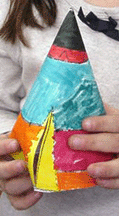
Teepees: Decorate a construction paper semicircle and roll into a cone shape. Glue toothpicks at the top opening to simulate the wooden frame.
T-shirts for Native Americans: Dye T-shirts light brown. Have children draw symbols on the shirts. Cut slits around the bottom and put beads on them.
Quiver of Arrows: Cut two rounded pockets and punch holes around the edge. Decorate the quiver shape with Indian symbols. Sew, leaving a long piece of yarn that makes the quiver “wearable”. Program arrow cutouts with vocabulary words to practice.
Recipes
Tortilla Tepees
Cut a 7 inch tortilla in half and form each half into a cone, overlapping slightly and leaving a center top opening about one-half inch across. Secure with a toothpick. Dip ends of pretzel sticks in canned frosting, then insert 3 pretzel sticks into center opening of each tepee and spread slightly apart, pressing against inside of tortilla to adhere. Dilute food coloring with water and use a paintbrush to make designs on the the side of the tepee.
Squanto’s Corn
Squanto taught the Pilgrims to plant corn by putting fish in a small hill of soil with the corn seed. The fish provided the growing corn with food. Use these materials to act this out.
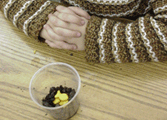
Crush two Oreo cookies in a ziplock baggie. Put half this “dirt” into a clear plastic cup. Add goldfish cracker fish and candy corn “corn”. Cover with more oreo dirt.
Popcorn: Pop popcorn, and tell the story of it being the first cereal! (the Native Americans introduced it to the Pilgrims) Make little canoes out of paper and eat your popcorn out of it.
Science
Animal Tracks: Use animal track templates to make animal tracks in clay or in plaster or to create rubbings of the tracks.
Songs & Poems
Ten Little Indians
One little, two little, three little Indians.
Four little, five little, six little Indians.
Seven little, eight little, nine little Indians.
Ten little Indian boys.
Ten little, nine little, eight little Indians.
Seven little, six little, five little Indians.
Four little, three little, two little Indians.
One little Indian boy.
Sitting Like an Indian
Sitting like an Indian (arms crossed)
Sitting like an Indian, just like an Indian.
Sitting like an Indian, just like an Indian.
Sitting like an Indian, just like an Indian.
Just like an Indian brave. (fingers behind head for feathers)
Beating my tom-tom just like an Indian…
Showing my feathers just like an Indian…
Sitting up straight just like an Indian…
Just like an Indian CHIEF! (use fingers of both hands for feathers)
Ten Days of Thanksgiving
On the first day of Thanksgiving the Natives gave to me…
a pumpkin in a pumpkin patch.
On the second day of Thanksgiving the Natives gave to me..
Two turkey gobblers,
and a pumpkin in a pumpkin patch.
On the third day of Thanksgiving the Natives gave to me…
Three Native headdresses,
two turkey gobblers,
and a pumpkin in a pumpkin patch.
On the fourth day of Thanksgiving, the Natives gave to me..
four cornucopias,
three Native headdresses,
two turkey gobblers,
and a pumpkin in a pumpkin patch.
On the fifth day of Thanksgiving, the Natives gave to me…
five bows and arrows,
four cornucopias,
three Native headdresses,
two turkey gobblers,
and a pumpkin in a pumpkin patch.
On the sixth day of Thanksgiving, the Natives gave to me…
six pairs of moccasins,
five bows and arrows,
four cornucopias,
three Native headdresses,
two turkey gobblers,
and a pumpkin in a pumpkin patch.
On the seventh day of Thanksgiving, the Natives gave to me.
seven Native teepees,
six pairs of moccasins,
five bows and arrows,
four cornucopias,
three Native headdresses,
two turkey gobblers,
and a pumpkin in a pumpkin patch.
On the eighth day of Thanksgiving, the Natives gave to me..
eight woven blankets,
seven Native teepees,
six pairs of moccasins,
five bows and arrows,
four cornucopias,
three Native headdresses,
two turkey gobblers,
and a pumpkin in a pumpkin patch.
On the ninth day of Thanksgiving, the Natives gave to me…
Nine ears of corn,
eight woven blankets,
seven Native teepees,
six pairs of moccasins,
five bows and arrows,
four cornucopias,
three Native headdresses,
two turkey gobblers,
and a pumpkin in a pumpkin patch.
On the tenth day of Thanksgiving, the Natives gave to me…
ten native tom-toms,
nine ears of corn,
eight woven blankets,
seven Native teepees,
six pairs of moccasins,
five bows and arrows,
four cornucopias,
three Native headdresses,
two turkey gobblers,
and a pumpkin in a pumpkin patch!
Literature
The Legend of Indian Paintbrush by Tomie dePaola
The Legend of the Bluebonnet by Tomie dePaola
Squanto and the First American Thanksgiving by Joyce Kessel and Lisa Donze
Squanto, Friend of the Pilgrims by Clyde Bulla
People of the Breaking Day by Marcia Sewell
The Circle of Thanks by Joseph Bruchac
Corn Is Maize: The Gift of the Indians by Aliki
Tepenum’s Day: A Wampoanoag Indian Boy in Pilgrim Times by Kate Waters
Related Posts:
 Thanksgiving and Turkey Math, Science, and Social Studies…
 Thanksgiving Bulletin Boards, Recipes, and Classroom Feast…
 Thanksgiving and Turkey Class Books and Literacy Activities
 Thanksgiving Turkey Art Activities and Crafts
 Thanksgiving and Turkey Songs and Poems
 National Symbols Activities, Lessons, and Teaching Ideas
